Global Alliance for Improved Nutrition (GAIN), Global Business School Network, Tuck School of Business at Darmouth - 15/01/2014
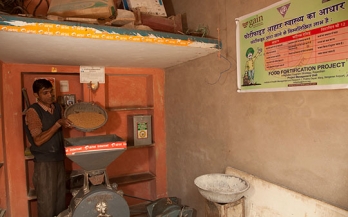
In support of the state government of Rajasthan and the Indian Integrated Child Development Services, the Global Alliance for Improved Nutrition (GAIN) launched a project to pilot a production model for producing supplementary nutrition via self-help groups.
Global Alliance for Improved Nutrition (GAIN), Global Business School Network, Tuck School of Business at Darmouth - 15/01/2014
This case study describes the approach taken between GAIN and AP Foods to scale up and improve their production of fortified supplementary foods, such as ready-to-cook mixes for common meals, and highlights the challenges, opportunities and lessons learned.
Global Alliance for Improved Nutrition (GAIN), Global Business School Network, Tuck School of Business at Darmouth - 01/01/2014
In India’s largest state of Rajasthan, a high percentage of children are undernourished and are not consuming the necessary vitamins and minerals they need to thrive. This case study describes project approach taken for producing supplemental food and also highlights the key lessons learned, challenges, and opportunities moving forward.
Magali Leyvraz, James P. Wirth, Bradley A. Woodruff, Rajan Sankar, Prahlad R. Sodani, Narottam D. Sharma, Grant J. Aaron - 03/10/2016
The Integrated Child Development Services in the State of Telangana, India, freely provides a fortified complementary food product, Bal Amrutham, as a take-home ration to children. This study was conducted to estimate the coverage and utilization of Bal Amruthama, a fortified complementary food product, and to identify barriers and drivers.
Jacky Knowles, Roland Kupka, Sam Dumble, Greg S. Garrett, Chandrakant S. Pandav, Kapil Yadav, Ndeye Khady Toure, Esi Foriwa Amoaful, Jonathan Gorstein - 21/04/2018
Single and multiple variable regression analyses were conducted using data from stratified, cluster sample design, iodine surveys in India, Ghana, and Senegal to identify factors associated with urinary iodine concentration among women of reproductive age at the national and sub-national level.
Jacky Knowles, Roland Kupka, Sam Dumble, Greg S. Garrett, Chandrakant S. Pandav, Kapil Yadav, Baitun Nahar, Ndeye Khady Toure, Esi Foriwa Amoaful, Jonathan Gorstein - 19/04/2018
Regression analyses of data from stratified, cluster sample, household iodine surveys in Bangladesh, India, Ghana and Senegal were conducted to identify factors associated with household access to adequately iodised salt.
Rajan Sankar, Tina van den Briel - 23/04/2014
Since 2006, the Global Alliance for Improved Nutrition (GAIN) has worked with a range of partners to improve access to nutritious foods for large parts of the population, through public and private delivery channels. This supplement presents a selection of activities to improve access to nutritious foods for large parts of the population, through public and private delivery channels.
Clémentine Antier, Salil Kumar, Sadhana Bhagwat, Rajan Sankar - 07/07/2014
This study was conducted to determine the operational performance, economic sustainability and social impact of a decentralised production model for India’s Supplementary Nutrition Program, in which women groups run small-scale industrialised units.
Frits Van der Haar, Jacky Knowles, Zipporah Bukania, Boubacar Camara, Chandrakant S. Pandav, John Maina Mwai, Ndeye Khady Toure, Kapil Yadav - 29/03/2018
This study used data from three population-representative surveys of women of reproductive age in Kenya, Senegal and India to develop a new approach to apportion the population Universal Salt Iodization levels by the principal dietary sources of iodine intake, namely native iodine, iodine in processed food salt and iodine in household salt.
Jacky Knowles, Greg S. Garrett, Jonathan Gorstein, Roland Kupka, Ruth Situma, Kapil Yadav, Rizwan Yusufali, Chandrakant S. Pandav, Grant J. Aaron, Universal Salt Iodization Coverage Survey Team - 12/04/2017
Household coverage with iodized salt was assessed in 10 countries that implemented Universal Salt Iodization.